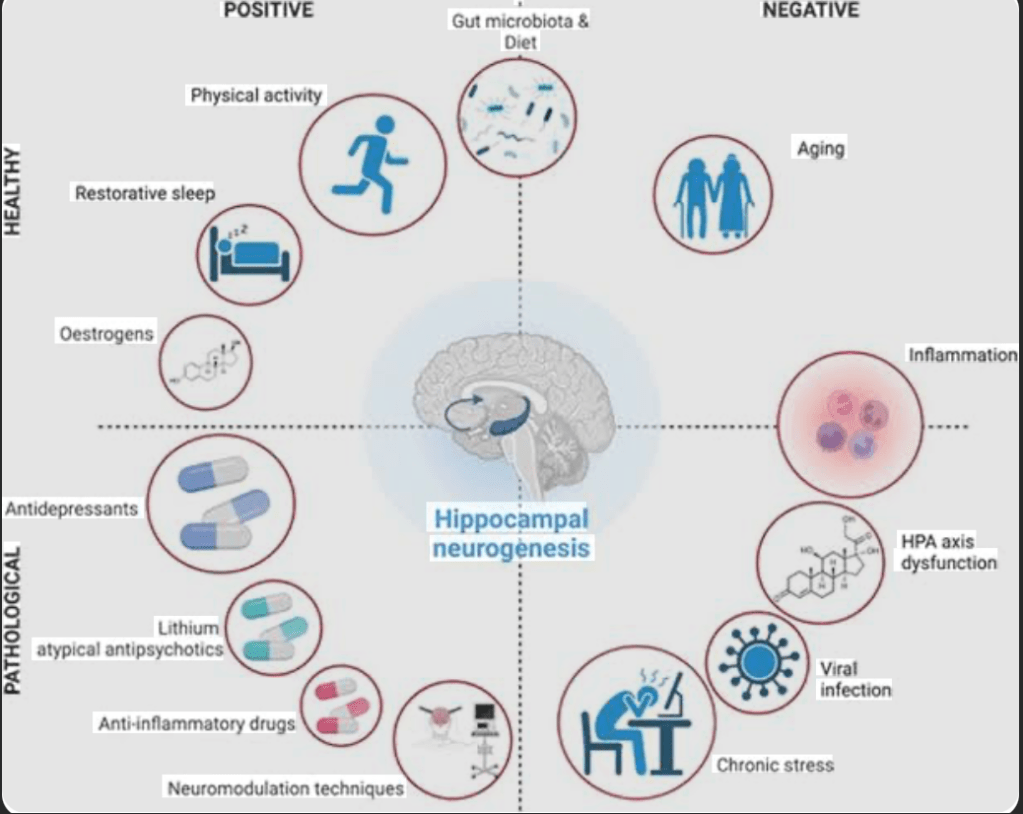
Research Task 1 — Adult Neurogenesis and Public Health
Research Question:
How could the discovery of adult neurogenesis influence future prevention or treatment strategies for neurodegenerative diseases such as Alzheimer’s?
Instructions (short):
- Define adult neurogenesis in your own words.
- Find one recent scientific article (2020–2025) discussing adult neurogenesis.
https://journals.lww.com/nrronline/fulltext/2024/01000/adult_neurogenesis__a_real_hope_or_a_delusion_.2.aspx - Explain how this discovery could affect public health approaches to aging or dementia.
Adult neurogenesis is the creation of a neuron in an adult’s brain. Further research into adult neurogenesis could allow scientists to potentially manipulate the phenomenon to produce desired results. Neurodegenerative diseases such as Alzheimer’s could be prevented or treated by spurring the brain towards generating new neurons which are less susceptible to neurodegenerative diseases. If this method were to eventually become a valid solution to neurodegenerative diseases, there would be widespread changes if said method becomes widespread and available. First of all, the burden placed onto families, caregivers, and individuals would decrease because individuals with Alzheimer’s generally require assistance with everyday life. As the disease worsens, individuals become incapable of functioning properly by themselves, causing physical and mental deterioration and eventually—in some cases—death. Second, the prevention/ curing of Alzheimer’s would decrease its mortality rate. Dementia, primarily Alzheimer’s, is currently the seventh leading cause of death worldwide. In the US, deaths from Alzheimer’s more than doubled between 2000 and 2022, and it’s the 6th leading cause of death for those 65+. The reason for this increase is caused by multiple factors, including the increase in average lifespan and smoking. In conclusion, the study of adult neurogenesis could provide crucial information to curing/ preventing neurodegenerative diseases.
Research Task 2 — Memory, Infancy, and Culture
Research Question:
Why do humans experience “infantile amnesia,” and what might this tell us about memory development from a biological and cultural perspective?
Instructions (short):
- Briefly explain infantile amnesia using neuroscience concepts.
- Introduce one cultural or anthropological perspective on early childhood memory (e.g., caregiving, language, or social interaction).
- Connect brain development to how societies understand childhood and memory.
Infantile amnesia is the inability of adults to recall memories from infancy. Recent studies suggest that the infant hippocampus can store memories once babies are around one year old, but it’s not clear why individuals cannot recall them once he or she grows up. Culture profoundly shapes early childhood memory. While Western cultures often emphasize personal experiences, specific details, and personal achievement, many non-Western cultures (East Asian, Turkish, Indian) focus on more social contexts, group activities, roles, and fitting in with norms. Brain development happens alongside early childhood, and is heavily influenced by the culture/society they live in.
 kjyworld.blog
Leave a comment