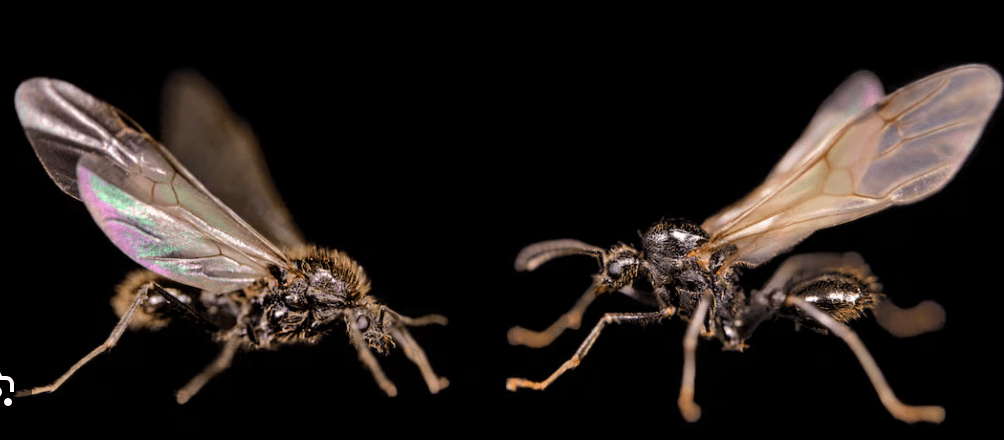
Ant Queens Birth Hybrid Offspring Using Another Species’ Sperm | Scientific American
The article describes how the Iberian harvester ant (Messor ibericus) queens use the sperm of another species, Messor structor, to produce hybrid worker offspring. Explain how this reproductive strategy works, and discuss the evolutionary implications of such a system.
The queen ants can use M.structor DNA to specifically clone M.structor ants. M.structor ants act as workers, so the queens are simply creating more helpers.
In the study, researchers discovered that on the Italian island of Sicily there were Messor ibericus colonies but no living colonies of Messor structor, yet the hybrids were still present. How did the researchers explain this phenomenon, and what mechanism allows M. ibericus queens to maintain the M. structor genome in the absence of mating partners?
The M.ibericus queens breed the M.structor clones, then breed with the clones to produce more hybrids. M.ibericus, in a sense, has domesticated M.structor genomes.
The article uses the term “sexual parasites” to describe the M. ibericus queens. What does this term imply in this context? How is this situation different from typical parasitism, and what are the costs and benefits to each species involved?
“sexual parasites” because they use the sperm from M.structor to breed hybrids to act as workers.
One surprising finding was that the cloned M. structor males produced by M. ibericus queens carried only M. structor nuclear DNA but mitochondrial DNA from M. ibericus. Why is this distinction significant, and what does it tell us about the mechanisms of inheritance and cellular evolution in this system?
This distinction is significant because it shows the M.ibericus queens can choose to clone M.Structor males by laying eggs that only contain M.Structor DNA in their nuclei. They have effectively domesticated the M.Structor species.
The article draws a parallel between this ant system and the ancient endosymbiotic event in which mitochondria became part of eukaryotic cells. Evaluate this analogy: in what ways is it accurate, and in what ways might it be misleading?
The two genomes have become a pair (M. structor and M.ibericus) benefiting the M.ibericus species.
Mitochondria became part of eukaryotic cells -> eukaryotes have two sets of genomes (one in the mitochondria, one in the nucleus)
Considering that the two ant species diverged more than five million years ago, how remarkable is the finding that one species can “domesticate” the genome of the other? What might this tell us about speciation, reproductive barriers, and the plasticity of genetic systems?
If one species can “domesticate” the genome of the other, would the survival of the other species be essential?
(since M.ibericus can produce ALMOST identical clones to M.structor- would the role they play in the environment still be fulfilled even if M.structor goes extinct?)
The article suggests this reproductive strategy might not spread broadly across organisms like the mitochondrial endosymbiosis did. Why might that be the case? What ecological, genetic, or evolutionary constraints could limit the wider adoption of such a strategy?
The methods are stated as unorthodox -> could be difficult for the strategy to be successful in other species for a variety of reasons (genetic, physical, etc..)
From a research methods perspective: what kind of genetic analyses or observations did the researchers perform to support their conclusions (for example, discovering clones, mitochondrial vs nuclear DNA differences, absence of the host species)? What are some potential limitations or alternative explanations they might have needed to rule out?
The researchers could have combined multiple independent lines of evidence — genetics, inheritance patterns, ecology, and population surveys — rather than relying on a single observation.
I learned that Messor ibericus queens use the genetic material of another ant species, Messor structor, to produce hybrid workers and even cloned males carrying the M. structor genome. Researchers used nuclear DNA analysis, mitochondrial DNA sequencing, and ecological surveys to show that these queens could maintain the other species’ genome even in places where M. structor no longer exists. This study demonstrates how flexible and unusual reproductive systems can be, and it raises important questions about speciation, inheritance, and the evolutionary relationships between cooperating species.
 kjyworld.blog
Leave a comment