https://www.scientificamerican.com/article/can-the-chances-of-a-successful-ivf-pregnancy-be-improved-with-ai
How is AI being used in IVF today?
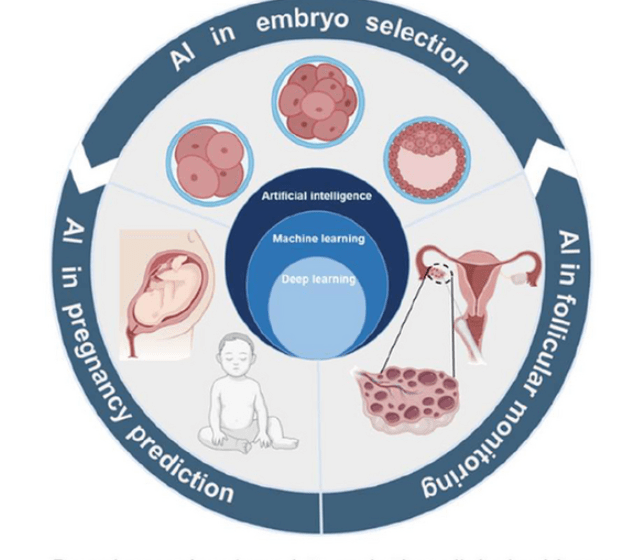
AI is used to assess whether a gamete’s morphology will lead to successful fertilization or to assess embryos for specific appearances and traits such as intellectual disabilities. Some training models are currently being assessed to see whether they can accurately predict the likelihood that a given sperm and egg will result in a successful pregnancy.
What information does AI analyze during the IVF process?
AI scans embryo traits and analyzes whether specific traits can affect pregnancy success. Typically, an embryologist inspects embryos and assesses their qualities.
Why might AI outperform traditional embryo selection methods?
AI could help establish clearer predictions of pregnancy success by analyzing large datasets and building a general model. Quoting from the article,
“By combining large datasets from sources such as HFEA, SART, and the clinical literature, we can model how many eggs, blastocysts, euploid embryos, and ultimately live births a patient is realistically likely to get.”
What limitations do researchers still acknowledge?
Our understanding of AI in the field of IVF pregnancy is limited by constantly changing data procedures between different countries. Reproductive technology itself is a very underdeveloped medical practice due to the small minority that are able to afford the procedure itself. Another limitation is that maintaining patient data sets to train AI would cost large amounts of money to keep secure from data breaches. Health data breaches both undermine patient privacy and cost the healthcare industry billions.
What could AI mean for the future of fertility medicine?
Various tests and experiments are being held to evaluate the effectiveness of using AI in fertility medicine. Some results show a promising future for utilizing AI in artificial pregnancies, but the current truth is that there is a lack of evidence showing that applying AI algorithms gives us satisfactory results.
 kjyworld.blog
Leave a comment